Showing posts with label 2012 Reviews. Show all posts
Friday, 18 January 2013
Review: BERBERIAN SOUND STUDIO
Argento. Bava. Martino. Fulci. Lenzi. Not the names of directors that everyone will be instantly familiar with but among fans of their chosen genre, giallo, they are hugely respected. Giallo is a catch-all term for a certain type of pulpy Italian thriller that rose to prominence in the 1970s with highly stylised visuals and scenes of extreme violence.
Director Peter Strickland has chosen to set Berberian Sound Studio, his latest film following 2009’s Katalin Varga, in the world of those giallo films. Quite literally; it takes place in the 1970s at the eponymous post-production studio where Englishman abroad, Gilderoy (Toby Jones), has been drafted in as a sound engineer on just such a film.
Gilderoy is a buttoned-up, unimposing figure still living with his mother and used to working on pastoral British works. He is immediately at odds with the brash, glamourous Italians and more concerned with doggedly attempting to reclaim expenses than the bella signorina he is dealing with in order to. His fastidious work ethic clashes with Italian methods, not least from producer Francesco (Cosimo Fusco), and it begins to take its mental toll.
To call it an assault on the senses would be to do it a disservice. It is a sensory celebration and a sonic appreciation of film itself. The film fetishises vintage recording equipment in a series of extreme close-ups which run throughout the duration. Considering the subject matter it is no surprise that the sound design of the film is remarkable. Scenes of Jones carrying out Foley work (using objects to recreate sound effects required for a film) are a joy to observe. Using and abusing enough watermelons, cabbages, marrows and radishes to make a hideous stew, it is an occasionally comic insight into what goes into making scenes of horror above and beyond the visuals.
For cinephiles, the film is a dream with a focus on technical aspects that assumes a prior knowledge of the way films are made. It positively worships film lore in a way that might leave some feeling excluded. There is a crucial authenticity in its depiction and is helped by the creation of film-within-a-film that seems entirely plausible. While the film is a drama thick with artistry, there are times when it would make for an excellent behind the scenes extra on a DVD.
It is worth noting that Berberian Sound Studio itself is not a horror-thriller like those it depicts. There is barely anything in the film you would identify with the genre. It is even left to your imagination what the characters see on screen in the film they are working on. It is, however, a sublime psycho-drama which focuses on a character whose boundaries between reality and fiction are rapidly melting and decaying like the gruesome pits of rotten vegetables the film lingers on.
The key reference point for this film would be David Lynch’s Lost Highway (although a good knowledge of Italian gialli will reap dividends in being able to spot references to genre traits, such as black leather gloves). While the world it takes place in is very different, there is a structural similarity that upends the entire film in a similar way.
It is an enigmatic spectacle that conducts its scenes like a symphony. Enjoyment will be dependent on how open you are to seeing something with a resolution that doesn’t make conventional sense and will leave you more puzzled than instantly gratified.
There are enough twists and breakdowns to leave you chewing it over for days after, trying to unlock its mystery – and that is a good thing. It is refreshing to see something so cineliterate and compelling without giving you any easy answers as to what it was about it that grips you from start to finish.
★★★★★
The original version of this review was published at STV.tv
Review: V/H/S
Like vinyl records before it, there is a growing wave of nostalgia for VHS tapes developing and this horror anthology attempts to tap into a yearning for the lost days of the video nasty. From nine different directors (including hot property in the genre, Ti West) across six films, V/H/S harks back to films like Creepshow and Cat’s Eye but adopts the current trend for found footage as a device; Tapes from the Crypt, if you will.
The advice when watching any portmanteau film also applies here: not every part will be good. It cuts back to one short as a buffer between films but there is no clear reason why that particular film should be the one. It is the least satisfying and if anything confuses things further. It could have done with something a bit more unifying hanging them together rather than just an aesthetic.
As far as the style of the film goes, enjoyment will largely be dependent on your tolerance levels for constantly dizzying camerawork that is always moving and spinning wildly. At the level it is applied here, it becomes headache inducing. The grainy first-person perspective, as ever, stretches credulity especially when faced with threatening situations but some parts do attempt to justify it.
The first proper story sets the bar very high as a group of obnoxious lads cross paths with a succubus. Think of it as a form of payback for Project X as a group of similarly misogynist yobs get their comeuppance. Ti West’s story is a more laid back affair which follows a couple’s journey down Route 66 where they attract the attentions of an unwanted visitor. It is creepily effective and strikes a balance between developed characters and jolt scares.
Other films attempt to do something a bit different including one which uses a webcam to hilarious effect. It is a shame that it was beaten to the punch slightly in this area by last year’s The Pact and Paranormal Activity 4 but it remains an innovate use of simultaneous point of view and reaction shots. Another goes all-out with a blistering haunted house film with remarkably good special effects. The only disappointing entry represents a dip in the middle of the film as it riffs on the ‘teenagers in the woods’ staple to no real effect.
The litmus test for any horror film though is whether or not it is scary and the answer here is unequivocally yes. The plentiful laughs and a nice visual gimmick are decoration - although it remains to be seen why it carries the title V/H/S when many of the films use a mix of far more up-to-date technology.
A few of the chapters can’t quite sustain their lengths, especially in this format, and it would have been helped by an ending which sought to tie it all together a bit more. Some might have been hoping for it to be transgressive, rather than the solid but unremarkable mix that it is, but as a loving tribute and innovative representation of the new wave, there’s no higher compliment than to say there are parts you will want to rewind and watch over. Now that surely makes it a film worth tracking.
★★★★★
The original version of this review was published at STV.tv
Tags:
2012 Reviews,
2013 Reviews,
Blu-ray,
DVD,
Edinburgh International Film Festival,
EIFF,
Review,
STV,
V/H/S,
VHS
Monday, 24 December 2012
Review: JACK REACHER
A loose cannon. A firebrand. A maverick, if you will. That’s how the character of Jack Reacher might have been described in the past. That said he’s still described in similarly hoary terms in this film; as the eponymous character himself puts it, he’s a “drifter with nothing to lose”. He certainly doesn’t play by the rules, or the law. He has no fixed home and moves from town to town wherever he’s needed.
It begins with a near silent ten minute opening as we watch a sniper coldly dispatch civilians. As an audience we’re positioned as the shooter and it makes for an uncomfortable watch. We see his point of view through his telescopic sight and the only sounds to accompany it are his measured breaths and isolated cracks of gunfire.
A potted history of Jack Reacher (Tom Cruise) reveals he’s a former military policeman who lives off-grid without any documentation or means of contact. He is called for by the supposed perpetrator and hooks up with his defence attorney Helen Rodin (Rosamund Pike) to investigate the situation surrounding the shooting, much to the chagrin of Helen’s father and local DA (Richard Jenkins) and dogged cop, Emerson (David Oyelowo).
Based on the ninth novel in Lee Child’s series of phenomenally successful Jack Reacher thrillers and adapted and directed by Christopher McQuarrie, best known for writing The Usual Suspects, the film has some pedigree behind it. Fans of the novels might be forgiven for doubting the casting of Cruise as a character known for being a man mountain but his hard-bitten performance, coupled with no mean amount of low-angle shots, gives him the presence required if not the stature.
Considering the hot button topic of gun control at the film’s core and the serious investigative elements that drive the plot, there’s still a place for blasts of humour – though some of it works better than others. While Cruise’s witty put downs to local hoods come with the twinkly charm we would expect from such a polished Hollywood presence, other moments offer a jarring change of tone just when things are getting going. It’s undeniably funny but there’s no rhyme or reason behind featuring a three-way fight scene with choreography that wouldn’t look out of place in a Three Stooges short. It sticks out like an appendage with an anvil-based injury among all the muscular, calculated set pieces of the rest of the film.
The film’s comedic ace comes in the inclusion of Robert Duvall as Cash, a rifle range owner who becomes the focus of part of the investigation. His presence paves the way for a double act of sorts with Cruise. Duvall’s no-nonsense, grizzled charm and laid back approach is the perfect foil for Cruise’s always-thinking Reacher.
The arrival of film director Werner Herzog playing the film’s chief villain, The Zec, marks a distinct uptick. He gives an icy performance as the milky-eyed mastermind but as soon as you hear that mellifluous Teutonic lilt it’s difficult not to bring to mind the weight of Herzog’s own personality, which does slightly overshadow the role. He’s given an opening monologue involving a Siberian prison and a “dead man’s coat” which certainly has all the hallmarks of one of his own voiceovers. His unflinching granite countenance makes a memorable impact each time he appears on screen but the real problem is that there’s just not enough of him.
Reacher aside, most of the characters are given short shrift. There isn't often a clarity to their motivations and many, particularly Pike's, are given little in the way of development. As if it weren't already clear from the above-title opening credits, where it declares this is 'A Tom Cruise Production' and stars Tom Cruise, by the end you are in no doubt this is unreservedly Tom Cruise's film.
While Reacher displays the unstoppable tendencies of a master tactician for most of the duration, it’s a welcome change when it comes to a bone-rattling car chase where he’s refreshingly rubbish; constantly clipping other vehicles and pinballing off sidings. It gives him a human side and shows he’s skilled but not prone to perfection. The rest of the action has the cool distance of being relatively long range and doesn’t feel a million miles away from watching someone play a first-person shooter game like Call of Duty or Medal of Honor. It lacks immediacy and, as a result, often feels anticlimactic.
As a throwback to the crime thrillers of a bygone era it's a success but it suffers slightly from being just too long. It’s some time before it really gets going and even by the end it’s not entirely clear just how some elements fit together. McQuarrie has a streamlined narrative in place but with the added burden of having to introduce Reacher for a presumed future franchise it buckles slightly under the pressure. Fewer characters – particularly of the disposable variety – and the removal of clearly telegraphed character shifts would have made for a tighter, tenser ride.
It’s a film of two halves and invariably the quieter dialogue scenes work far better than the protracted forays into action. There’s plenty mileage in Reacher as a character, even though it isn’t fully explored here, but the fact he isn’t motivated by financial gain, or just in the wrong place at the wrong time, makes him interesting in the canon of big screen heroes. While inevitable elements of the White Knight trope creep in, there is darkness to him rarely witnessed in his contemporaries.
★★★★★
Tags:
2012 Reviews,
Jack Reacher,
Review
Thursday, 6 December 2012
Review: SEVEN PSYCHOPATHS
Where to start with Seven Psychopaths? It’s so scrappy and sprawling that it is hard to quite get a handle on. Employing meta techniques it’s ostensibly the tale of struggling scriptwriter, Marty (Colin Farrell), trying to flesh out a screenplay he’s writing called Seven Psychopaths. It’s also a caper about a bungled dog kidnapping with which Marty is tangentially involved through Billy (Sam Rockwell) and Hans (Christopher Walken). Things get confusing when the writing and ‘real’ life get intertwined and urban legends reveal their roots in reality. All the while, characters pass comment on how the film-within-a-film, as well the one we’re watching, should play out.
Director Martin McDonagh’s last film, In Bruges, was a resounding success; managing to be scurrilously entertaining with endless ribaldry and enough heart to make sensitive leads of a couple of hitmen on the run in unfamiliar territory. On paper Seven Psychopaths looked to be playing to McDonagh’s strengths with another tale of gangsters and Colin Farrell playing someone lovably out of his depth.
On a dialogue level, it’s very funny indeed. Farrell plays against type as a pacifist boozehound who prefers to be sidelined. The badinage between him and Rockwell’s motormouthed showboater is the spark that keeps the film alight under the weight of the smothering postmodernism. That’s not to say Rockwell isn’t also intensely irritating; given to shouting at random and wearing silly animal hats. Thank heavens for the calming presence of Christopher Walken whose typically languid delivery cuts through every scene he’s in, elevating it with just the intensity burning in his eyes and the size of his hair.
It’s when listing the performances that you might notice no mention of any women. It’s not that there aren’t any, although that might as well be the case. While the characters point out the short shrift that women receive in film in general, this is carried over into this film. The only female characters are shrewish (Abbie Cornish), sex objects (Olga Kurylenko) or the butt of a joke (Gabourey Sidibe). One female character gets a brief moment to shine as Hans’ wife, Myra (Linda Bright Clay), has a tense standoff with Woody Harrelson’s Mafioso villain Charlie Costello but as a result of the script playing so fast and loose with relevance, even the impact of that is lost and quietly forgotten. Comically referencing poor treatment of women in offhand fashion isn’t enough to make us forget it’s happening here.
Fortunately it never slows to a pace where you’re afforded the time to think about the myriad problems it has on a structural level. It survives scene to scene if you can take them in relative seclusion and enjoy the dynamics of it. By attempting to piece it all together, that’s where it begins to fray at the edges. A barrage of cameos including Michaels, Pitt and Stuhlbarg, keeps things breezy but the appearance of Tom Waits proves one of the highlights when he appears as a rabbit-carrying consulting psycho whose back-story provides the film’s crowning glory.
These parts of the film are astonishing in just how well directed they are. There are flashes of the sparkling brilliance McDonagh displayed with In Bruges but they are fleeting and oddly at cross purposes with their intention. It’s a cruel irony that the cutaway scenes, such as Waits’ tale, which are used to take the piss out of the quality of the script being written, are so well handled and genuinely captivating that they make you wish they were the film you were actually watching.
It has a vibe oh-so reminiscent of any number of late-Nineties, post-Tarantino indie movies that often dealt with a heist gone wrong or Hollywood satire, but with a post-Adaptation sensibility. Both are strong reference points which, in theory, should sit nicely together but the juxtaposition proves that they work far better in isolation.
There’s enough fine work in the dialogue to allow a degree of forgiveness for some of the meta baggage the film is saddled with. While the interconnected tissues of some of the sinuous elements are stitched together by a steady hand, there’s the distinct feeling as it plays out that other ruptures are bleeding away under the surface. As you’re watching it becomes aware it can only hold for so long and will take some spectacular field surgery in the last act to save it.
One of the key themes throughout the film is how it should end. Billy is convinced it should end in a spectacular gung-ho bloodbath. That kind of unifying display might just have pulled all the elements together – it certainly needed something big and assured - but there’s the feeling by the end that Billy might have been disappointed with the outcome.
★★★★★
Tags:
2012 Reviews,
Review,
Seven Psychopaths
Wednesday, 5 December 2012
Review: PITCH PERFECT
Anna Kendrick, in her first leading role, is Beca; a retiring alternative type. We know this because she has Daddy issues and she's into DJing. She feels completely at ease dropping knowledge of David Guetta into a conversation and produces mashups, such as the Proclaimers one she drops early on to clue the audience into her cred.
She reluctantly joins the Bellas, one of her new college's four a cappella singing groups (including one populated by, unbelievably, a group of stoners), because apparently these students haven't heard of partying or studying. We don't even find out what any of the characters are actually studying or see them attend a class throughout the entire duration of the film. Instead there’s a regional singing competition as the familiar hook the film’s structure is hung upon.
In what seems like a taken-as-read romantic subplot rather than any kind of natural character development, Beca becomes suddenly entangled with Jesse (Skylar Astin) from a rival a cappella team with whom we see little semblance of any kind of romantic ritual develop. It just happens because we're expected to expect it to. He's another sensitive soul and we know this because he can list his favourite film scores to clue the audience into his cred. He’s the type of dreamer who doesn't mind showing a potential amour the last two minutes of The Breakfast Club, rather than the entire film, to woo her.
The film unfolds in typically predictable fashion but that’s alright because they ironically acknowledge this predictability in the dialogue. Tensions arise within the singing group and a battle for dominance takes place among the ragtag bunch of girls who are hilariously fat/psycho/lesbian/prissy/slutty. The musical numbers which pepper the film are a welcome diversion from the stuttering plot dynamics and themes of acceptance which it tries hard to point out aren’t like Glee, while being exactly like Glee.
Puns on a cappella are grating at first when used earnestly but become head-punchingly annoying when they’re later used frequently and ironically. Non sequiturs and funny voices are threaded throughout in place of anything truly remarkable. When hitting a comedic dry spot, a pratfall or grope will paper over any cracks and if running really low, unnecessary cameos from Elizabeth Banks (who also serves as producer), Har Mar Superstar and Christopher Mintz-Plasse will momentarily divert your attention.
Rebel Wilson as another member of the Bellas gets most of heavy lifting to do when it comes to the comedy. She’s a talented comic actress but she’s not allowed to display anything beyond the unhinged act she’s displayed in all her most recent films. It’s an irony that her character adopts the moniker ‘Fat Amy’ to undercut the jibe being used against her by others when it’s the same trick she’s being forced to use as an actress; play the one-note, big kooky girl who embraces her image in everything and continue to get cast in supporting roles. It’s a shame because she’s clearly capable of more.
It’s no surprise that Wilson was also in Bridesmaids because that’s exactly what they’re pitching at here. It’s a female-led comedy that deals with relationships between women but there’s not an ounce of the nuance shown there. Most pleasingly it doesn’t resort to having an out-and-out bitch character – at least not among the girls – but there is a misjudged running gag about bodily functions that seeks to rival Bridesmaids in the gross out stakes. It wants to be raunchy but even that is dialled down. The most you’ll get is a few “bitches” and a performance of Rihanna’s S&M.
In a film that seems to place prominence on accepting people for who they are, there’s a strangely distasteful thread of meanness towards Asian women which crops up in two distinct circumstances. Firstly, Beca’s inexplicably cold and aggressive roommate who is only afforded one cursory off-screen moment to break stereotype and, secondly, a spooky member of the Bellas who speaks in hushed whispers and betrays a dark past of arson and a “dead body”.
It has all the hallmarks of a post-Mean Girls teen flick with bite but it’s lacking in a sense of identity. It’s never quite sure exactly whether it wants to be a satirical exploration of teen movie tropes in that vein, a celebration of harmony of both voice and disparate personalities coming together or something more dramatic as expressed in the way which it attempts to deal with Beca’s sense of isolation. It tries to be all but never comes close to pulling it off.
The characters just don’t connect. There’s nothing to root for in the romantic subplot and the entire cast of characters, aside from Beca, are so underdeveloped beyond a signifying quirk that they can’t hold your interest. While there is a joy to watching impressive vocal stylings among the various groups, the rest of it is the equivalent of watching the other bits of The X Factor.
Far from perfect.
★★★★★
Tags:
2012 Reviews,
Pitch Perfect,
Review
Friday, 16 November 2012
Review: THE MASTER
Following up There Will Be Blood was always going to prove troublesome for Paul Thomas Anderson in light of his varied career of works tackling broad scopes of numerous eras and genres. After the relatively epic sweep of his epic oil drama, it was a bold move not to dial it down and dilute the style he developed therein. The Master not only picks up many of the same themes but fashions them into something even more discordant and demanding.
A little before the end of the
first act, Freddie Quell (Joaquin Phoenix) is awoken by a stranger to be told,
“You’re at sea”. The person delivering that message in the literal sense is
possibly only partly aware of how apt that phrase is for Freddie is indeed a
man adrift. He’s a lost soul scrambling from job to job and misdemeanour to
misdemeanour after serving his country in the South Pacific in World War II.
Unable to settle down, he’s lead by the nose in search of hedonistic excess
and fuelled by any intoxicant he can lay his hands upon – as a spell drinking
developing fluid during his job as a department store photographer exemplifies.
It’s when his path converges with
that of a nascent spiritual organisation led by the enigmatic Lancaster Dodd
(Philip Seymour Hoffman) that the gears of a direct plot begin their slow grind
into the position they’ll occupy for much of the film. This is not a film
which concerns itself with grandiose character arcs; more concerned as it
with the eventual power play between the antagonist and protagonist.
As Dodd attempts to diagnose and ‘fix’
Freddie through the processing stages of his religion there’s a curious
dynamic at play. Warm with an undercurrent of genial malice, Dodd seems
enamoured of his new ward in spite of his “scoundrel” tendencies and it’s the
formation of a symbiotic relationship that forms the backbone of the film.
The strength of it lies in the subtly shifting balance of power to the point
where you’re never quite sure who's
benefitting more from Freddie’s betterment. Is his turnaround the redemptive
makeover an audience is presumed to root for, or vindication of a possibly
on-the-hoof doctrine?
Powerful scenes raise questions about this fledgling religion but the
mooted Scientology skewering is merely a jumping off point for an examination
of the relationship between these two outwardly different, but similarly in
turmoil, men. It’s in these intricacies that the joy of the film lies.
There’s no such thing as an easy answer or an easy question.
★★★★★
In discussing humanity’s need to always have something to follow it
doesn’t shy from tackling the theme of religion head on but it does so not
from an embittered standpoint, but from one of genuine inquisitional
interest and a desire to probe human nature. It’s neatly summed up in
typically impressive form by Dodd, who calmly goads: “If you figure out a way
to live without a master, any master, be sure to let the rest of us know for
you would be the first in the history of the world.”
There is a real sense of development in the characters throughout the
film and, evidently, long before shooting started. They feel lived-in and there
is the sense that both Hoffman and Phoenix know them inside and out. It’s
tempting to think that Phoenix’s entire experience with I’m Still Here was a
tentative fumbling towards his petulant and infuriating character here. It’s
certainly an astounding performance that will define his career from now on.
The interplay between the two leads sparkles with latent energy and in some
respects their relationship has more in common with Apatowian bromance than
it does with even previous Anderson films.
While on screen for little of the film’s engorged 144 minute running
time, Amy Adams' powerful performance as Dodd’s wife is impactful in every
scene and is potentially key to unlocking the relationship between the men.
She’s quietly dazzling and worlds removed from her stock in trade sweetness we’ve
grown accustomed to.
It’s certainly a handsome production. The captivating cinematography
of Mihai Malaimare Jr captures an essence of the 1950s period aesthetic and punctuates
the film with the most stunning shots of azure seas. Coupled with an avant-garde
use of editing techniques and dissonant score from Radiohead’s Jonny Greenwood,
it’s as much of a joy visually as is it for those who enjoy grappling with
the complexities of a story which thrives on individual scenes as much as it
does their part in a whole.
Careful balance is integral and it importantly doesn’t outstay its
welcome. As a portrait of Phoenix’s character it exudes a sense of otherness
in every frame. He never quite looks part of this world and there’s an
overpowering sense of being lost in his surroundings. The fact you’re
unlikely to grow fond of him doesn’t make that any less touching and it’s the
quiet warmth afforded his character that makes this so extraordinary and
devastating. Some men just can’t be tamed.
While all this might sound well beyond po-faced and deep into the
realms of drudgery, there’s room within for exploration of a sweeter nature
with a probing of potential tenderness in Quell’s past, but even that isn’t
quite clear cut in a narrative sense. Humour flares in unexpected places (particularly
an exemplary use of a well-timed cussword) and ensures that the dynamics of a
scene are liable to uproot you at any moment.
It’s a rich, heady mix which simultaneously invigorates and numbs the
senses like a paint thinner cocktail. It constantly requires more of its
audience and the more you devote to it and invest in the world and the
minutiae, the more you’re likely to reap from it. It doesn't have the immediacy
of There Will Be Blood or the instantly accessible qualities of Boogie Nights
or Magnolia but it lights up the screen and it’s destined to leave you
stewing afterwards. Whether your reaction to that is positive or negative, it’s
invigorating and there won’t be any denying that impact was achieved.
Tags:
2012 Reviews,
Review,
The Master
Friday, 5 October 2012
Review: TAKEN 2
Unlike many action film sequels, Taken 2’s strongest card is that it isn’t a case of, “How can the same shit happen to the same guy twice?” Bryan Mills’ (Liam Neeson) role in this is comes as a direct result of his jaunt to Paris in 2008 and more specifically as a result of the disposable goons he mercilessly killed in order to save his daughter. Turns out said goons had powerful families who now seek to avenge their deaths.
That’s not to say there isn’t a degree of contrivance involved in bringing all parties together in another foreign city. Moving from Paris to Istanbul this time, it mildly subverts expectations by making Mills’ daughter Kim (Maggie Grace) less of a victim and more instrumental this time around, all the while managing to crowbar in scenes reminiscent of the most popular from the original.
So we get the phonecall as he calmly talks his daughter through the situation. We get the threats to his assailants as he delivers his intention to kill them. We get the storming of dilapidated residences filled with leather jacketed heavies. It does seem forced but it makes sense he’d employ similar tactics. These are aspects of his character and his methods in the same way that John McClane might crack wise after a fumbled dispatch or John Rambo might grunt while stealthily slitting someone’s throat.
It’s easy to forget that his role in Taken was the one that reinvented Liam Neeson to an extent. For an audience used to seeing him in dramas or as noble mentors, it was a genuine shock to see him coldly rampaging across Paris. By nature of its sequel status we don’t have that same luxury here. We know exactly what Mills can do and so all the film can do is try to top what we’ve already seen by raising the stakes.
By bringing along his estranged wife Lenore (Famke Janssen) and having her in peril, it adds another layer. Her character doesn’t add much but the effect her inclusion has is efficient. Rather than wading into the situation with literal guns blazing as he did last time, the impetus here is getting out of it and rueing his involvement in the first place.
The film’s biggest problem lies in the handling of the action scenes. In chasing a younger demographic the fight scenes have lost any sense of weight. The brutality is replaced by a series of incomprehensible fight scenes and logical leaps that render them near-worthless. The sound mix is so softened and the edits are so rapid that all you see are flailing limbs and aftermath with bone-snapping cracks replaced by light whumps that sound like pillows landing.
All of the visceral no-nonsense joy is sapped. The car chases across crowded Istanbul bazaars and narrow streets fare better but even those feel dampened by the fact that they’re a staple of the genre. Rade Sherbedgia’s chief villain is deftly handled in spite of awkwardly literal dialogue but for a film which focuses on the personalisation of the villains as a key plot point, each of the rest of them are nonentities only there to wave guns and serve as convenient action beats.
Like the first, the scenes of Mills in normality are faintly laughable with echoes of his daughter’s embarrassingly false teeny pop idol obsession and U2-following Euro tour of yore. An ill advised subplot about Kim’s first boyfriend is played strictly for laughs and veers into parody as Neeson plays protective father for comic effect. Kim’s convenient ambition is now passing a driving test which unsurprisingly comes into play as she uses it as a means to bond with her father in both LA and when at risk.
At more than one point in the film it borrows tracks from the soundtrack to Drive. An odd choice with such a lauded film so fresh in the memory but it has to be assumed that using Chromatics’ Tick Of The Clock in exactly the same context as Nicolas Winding Refn’s film has to be an obvious homage rather than rip off. However it does raise the question of exactly what tone the filmmakers are aiming for.
Softer than the first instalment in themes and action and with unexpected comedic elements weaved throughout, it never quite hits the same highs as the singular Taken. While the plot must be applauded on some level for providing a logical response to previous incidents, it’s a generally satisfying sequel rather than equal.
★★★★★
★★★★★
Tags:
2012 Reviews,
Review,
Taken 2
Tuesday, 2 October 2012
Review: THE PERKS OF BEING A WALLFLOWER
It comes down to more than just this but you know when one small thing in a film causes it to instantly lose you? That.
Set in a Pittsburgh of indeterminate year, the film sets up our teenage misfit protagonists as musos; outsiders whose lives are punctuated by key songs that define moments. They listen to Nick Drake and use obscure songs by The Smiths as tonal shorthand for us to realise how deep they are. They make wilfully clued-in mixtapes and comment about how great it is when Dexys Midnight Runners get played at a lame disco. These kids, these precociously switched-on lyrical brats, hear Heroes by David Bowie on a magical car journey and none of them know what it is.
Is their non-recognition them being achingly hip and oh-so arch? Acknowledging the fact that it’s among the best known songs by an instantly recognisable artist and scoffing at how pointedly it underscores their position? They must know the song, right? Nope. Turns out they don't and it becomes a poignant plot point that they uncover the obscure recording artist behind this little heard track.
It might seem like a small point but it encapsulates the problems of the film. It’s so focused on what looks or sounds cool within a scene that it forgets whether or not it distracts from what matters.
So long is spent on establishing the outsider status of our heroes that they make up for in affectations what they lose in characterisation. You've got Ezra Miller's acid-tongued, gay Patrick (who expresses his sexuality through on-stage, dragged up sing-alongs of The Rocky Horror Picture Show); Emma Watson's surface level, seemingly together Sam who is actually a whole mess of turbulence underneath; and central character Charlie, played by Logan Lerman, who we're informed has a history of tragedy in both his family and social life and has previously suffered a breakdown.
It’s a potent mix for a film with this demographic and Miller and Lerman’s performances are particularly good. A supporting cast, which includes Paul Rudd as a warmly influential teacher and Pittsburgh local hero Tom Savini, help scatter the film with individual charming scenes but never really help coax it onwards. Ultimately the teenage dilemmas which drive the film lack sufficient exploration beyond soap opera arcs and Emma Watson is distractingly miscast. Never able to convince that her character has an ounce of the history she professes, she serves little dramatic purpose beyond romantic foil for Charlie.
When the plot seems torn between whether it’s a romantic drama or psychological study of repressed memories, each tender melodrama is an unwelcome interlude. Both strands work well in isolation but rarely form a workable symbiosis.
It's in the age difference of three years between Charlie and his cohorts that shades of This Is England start to appear. It's not overt but there’s almost the sense of an Americanised retelling; this youngster who starts to find his identity through hanging out with older peers and discovers a sense of belonging through the world of music, literature and drugs they introduce him to. It never strays into the same darker areas as This Is England but it’s riddled with many of the same touch points – even down to our hero’s relationship with the weird, shaven-headed older girl.
It’s undoubtedly affecting at times in spite of its multiple flaws and while attacking the themes with an occasional dearth of finesse, there is some profundity in there. As Patrick states in one scene, his life is like an “afterschool special”. It’s fine to acknowledge that but it doesn’t excuse the fact that the film has been written in such a way.
Having harped on about the use of music in the film it seems churlish to point out that the jukebox soundtrack is actually very good and the song selection perfectly balances out the slightly wistful cinematography.
We open with a countdown and the film ends accordingly; time has passed and lives have changed but the rigidity of that time period make those life changing events appear glossed over in pursuit of a framework. When so much time is devoted to letting us know just how much our heroes stand out from the crowd, it’s just not clear exactly what the perks of being a wallflower are.
★★★★★
Tuesday, 18 September 2012
Review: ABOUT ELLY...
Simmering tensions and questions of honour enshroud a group
of Iranian friends and their young families as they visit a villa by the sea. The
eponymous Elly (Taraneh Alidoosti), one of the children’s teachers and friend of
central female figure Sepideh (Golshifteh Farahani), is invited along with the
group as a potential suitor for one of their number but things fall apart when
she disappears during a flurry of potentially fatal activity.
What begins relatively sedately gradually shifts to
something more uneasy. Suspense is ratcheted up little by little as more
revelations about the missing woman, and her acquaintances, come to light. By
the time of the third act it is heart in mouth stuff. The sense of unease
created through characterisation alone is palpable.
Accusation and apportioning of blame is the focus of much of
what transpires but, as all that is happening, human frailty is exposed. It
never explodes in the way that you might expect. Guilt manifests in various
guises with each character choosing to cope in a different way. The ensemble
seems all-encompassing while never seeming artificially forced together to
satisfy a need for different types.
While not a thriller in a traditional sense, it has enough
of those elements to make it thrilling. It has more to say about domestic life
in Iran than it does the story of a missing person. Featuring some of the cast
from Asghar Farhadi's later work, A Separation, the performances are all
pitched at exactly the right balance of natural and heightened.
The dynamics between the different couples which make up the
party are fascinatingly rendered. The interplay among, and between, couples can
swivel at a moment’s notice. Where you might expect the female characters to
languish among such strong male interaction, their characters are forcefully
well realised. No one sex is more culpable than another when it comes to the
problems encountered but the gender balance comes into play in enthralling
ways.
Farhadi is proving himself a force in world cinema capable
of telling intense human stories with a minimum of fuss and scarcely a frame
wasted in telling the emotional story behind the events.
Overcast skies and expressionistically colourless vistas
aren’t maybe what you’d associate with a Persian landscape but they’re used to
great effect here from the moment the film’s pivotal event takes place. The
cinematography has a satisfyingly loose style that fits the flux of the action
and is ramped up when needed, most notably during an anxious rescue.
It's rich and textured in a completely unhurried way and for
those unfamiliar with the inner workings of Iranian society it's a fascinating
insight. Emotionally mature and occasionally agonising, it's a work of quiet
tragedy that rarely sets a foot wrong.
★★★★★
Tags:
2012 Reviews,
About Elly,
Review
Sunday, 16 September 2012
Review: PARANORMAN
The presence of Tim Burton and Henry Selick loom large over
this film. While not in an official capacity, the world of horror inflected
stop motion animation is their hallowed turf. Anyone seen to be breaching this
ground is bound to be labelled a sub-par intruder but the makers of ParaNorman
have equalled, if not bettered, those by the sub-genre superstars.
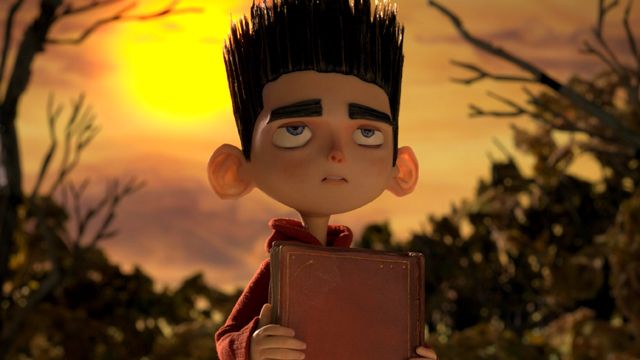
Taking its cues from The Sixth Sense, ParaNorman concerns
eleven-year-old shock haired Norman, who can converse with dead people.
Cleverly that isn’t seen as a problem though – at least not for him. The
problem lies in the eyes of others; from his concerned mother and appalled
father to bullying contemporaries at school.
For a film that starts out with a flickery grindhouse homage
and the image on a trodden-on brain, it’s no surprise that the film is uncompromising
in its content for a film with this demographic, and rightly so (sample joke topics:
homosexuality, goosing, tits and ass). It would be untenable and pointless to
construct a film – animated or not – around the subject of the risen dead and
not pay homage to genre hallmarks.
That’s not to say there isn't a moral backbone to this illicit
children’s film. It is warmly nostalgic in its vision of warped Americana and
the central tenet of accepting difference in others runs through it like fresh
brains through a putrefying intestinal tract. There’s an infectious glee in the
way it doesn’t hold back on showing gruesome sights, such as a corpse’s lolling
tongue flapping onto our hero’s face.
The character design is positively grotesque – and that’s
just in the living. Blotchy skin, puffy eyes, asymmetrical faces, wobbling
bingo wings and monstrously protruding guts all feature heavily. The voice cast
seem to completely inhabit their parts. Softly spoken Kodi Smit-McPhee is a
beguiling lead as Norman, in stark contrast to his flustered parents voiced by
Leslie Mann and an exasperated Jeff Garlin. Playing against type, Casey Affleck
is completely unrecognisable as a lunk-headed Jock while Anna Kendrick flies in
the face of her usually prissy screen persona as Norman’s callow, vapid sister.
If anything, the characters are too stock but even that’s in keeping with much
of the genre it riffs on.
While obviously dancing in the general area of parody, the
film doesn’t stuff itself with references to other films. This is its own
thing. It takes time to establish its own world, drawing from sources as varied
as gory b-movies and its New England setting's history of puritanical witch
trials. The influence of John Carpenter does make itself apparent in the score
and a couple of sly nods to Halloween but never to the extent that it seems
homage is more important than plot.
What will leave the most lasting impression are the stunning
visuals. The model work and stop motion have a tactile charm but in coupling
those with fantastically audacious camerawork and liberal application of CGI,
it reaches new heights. The autumnal hues and ragged aesthetic give it a lived
in feel that completely fits the plot and the characters that inhabit it. A
scene of atmospheric turbulence in the skies above the town of Blithe Hollow is mind blowing in
how well realised it is.
Of course it’s relatively bloodless and the undead of the
film are rarely concerned with anything worse happening to them than losing a
dangling limb. Of course when that limb is 300 years old and decaying, it’s all
played for comic effect. There’s nothing too troubling – at least no more so
than munching on a jelly brain sweet.
Pleasingly plot driven and without the unnecessary baggage
that usually accompanies message focused animated films, it’s a flesh creeping
delight. It might not have the innocent charm to guarantee its longevity but
it’s a delightful, if slight, romp that doesn’t scale back on the visceral
pleasure of watching a horror film.
★★★★★
Tags:
2012 Reviews,
ParaNorman,
Review
Thursday, 13 September 2012
Review: HOPE SPRINGS
What happens when an unstoppable force (Meryl Streep’s
unbridled optimism) meets an immovable object (Tommy Lee Jones’ craggy scowl)?
Well, they go to marriage counselling and seek to repair years of damage to
their emotions and libido.
The film’s biggest strength lies in the fact that it’s very
much a two-hander. It’s absolutely Streep and Jones’ film and both actors are
more than game. It’s solidly structured around these two with only one
significant supporting actor in the form of Steve Carell’s therapist. As such
it doesn’t feel cluttered and eschews unnecessary comic relief.
It’s relatively gentle humour in spite of broaching the
subject of sex matter-of-factly but it plays to the actors’ strengths. The set
pieces are fun but never at the expense of characterisation. Jones’ guttural
growl when faced with uncomfortable situations is always pleasing and Streep
takes charge of the film’s more heightened moments with seemingly effortless
panache.
It’s warmly natural, touchingly tender and occasionally very
funny. It’s not quite as predictable as you might expect and character
expectations are sensitively subverted. The progression feels balanced and
fair; it’s not a battle of the sexes. It walks the fine line between schmaltz
and melodrama (in the best possible way) while managing a few barbs but doesn’t
resort to comedy of embarrassment tropes.
It has a lot to say about relationships and how, without
noticing, they drift into monotony and need reassessing – especially as years
turn to decades. It might not be breaking new ground but they’re resonant
themes and it’s refreshing to see sex approached in a way that isn’t puerile or
throwaway.
Unfortunately it’s slightly marred by a jarringly fast wrap
up and an ill-suited punchline (that strangely chimes with similar problems in
the last act of Take This Waltz) but there’s plenty to admire in the thoughtful
restraint of this post-middle age comedy-drama.
★★★★★
Tags:
2012 Reviews,
Hope Springs,
Review
Monday, 10 September 2012
Review: DREDD
It looked like 2000 AD’s toughest lawman would never see the
big screen again. A string of flop films based on ‘mature content’ comics and a
much maligned previous adaptation in 1995 had seemingly put paid to that.
But here it is. It’s uncompromised, it’s adrenalised, and
there’s no Stallone in sight. It’s also one of the most visually revolutionary
action films of recent years. Establishing the lore of this dystopian future
and setting up the grand scale of Mega-City One, before confining the
bulk of the action to one location, is a remarkably effective way of allowing
for characterisation of Judge Dredd himself.
For the Dredd of Alex Garland and Pete Travis’ vision is not
quite the indestructible, gung-ho portrayal that’s attached itself to the
character in the past. Karl Urban’s Dredd expresses caution, restraint and
faith in other characters. While not shying away from all the action hero stuff
you’re watching for, he’s more rounded than could reasonably be expected.
His interaction with rookie Judge Anderson is a sheer joy to
behold. The entire treatment of the Anderson character is fascinating. Not only
is her character nuanced and well written but they way the filmmakers have
handled her powers is impressive. The portrayal of her psychic powers is immaculately
realised in a way that makes X-Men’s similar approach look frankly silly.
Anderson is one of two genre-defying well rounded female
characters. Lena Headey as the film’s villain, Ma-Ma makes an invigorating
change in that her sex is almost incidental. It’s never dwelled upon or used to
affect her actions. She’s brutally cold but softly spoken and with a calm demeanour
and that’s what makes her scary. A scene recounting her back-story could have been
a hackneyed piece of exposition but it’s told with such a visual flair that it
never feel like it is.
There’s a grounded feeling to the way that Mega-City One has
been developed here. From shot to shot it looks real world (a result of its
South African shoot and budget) but in landscape shots it’s fascinatingly
structured; relatively ground level slums studded with vertical cities in the
form of the blocks. Budget limitations do show elsewhere, not least in Dredd’s
Lawmaster bike that looks like a fibreglass bug shield tacked onto the front of
someone’s Yamaha.
Where the film really succeeds is in its usage of slow
motion. By making slo-mo imagery a side effect of the narcotic of the same name,
it becomes not just a stylistic effect but a diegetic device. It thickly coats
the imagery in a translucent sheen that’s translates beautifully to the screen.
While slow motion isn’t new in action films it has rarely looked as good, or
made as much sense, as it does here.
Comparisons with The Raid are inevitable due to the tower
block setting and similar plot beats but there’s much more at stake here. While
The Raid tied itself up with manufactured twists, Dredd is more concerned with
using the location and device of secluding the heroes as a means of world
building.
There’s a minor problem in the disposability of many of the
villains but that’s cleverly explained away by a lean plot mechanism: they’re
not henchmen, they’re ordinarily people cajoled into action. It adds an extra layer and is effectively
explored in a scene involving Anderson and a mother whose husband has adopted a
role as bounty hunter.
At 95 minutes, it never leaves time to get stale. The block
is so well realised as a location that it seems like they could have afforded
further time to investigate it. The dark humour of the comics makes an
appearance (not least in some spectacularly gruesome deaths) but never feels the
need to offer a comedy sidekick to liven things up. With the world now established
on screen, seeing other corners of Mega-City One’s sprawling metropolis
explored could be an intriguing prospect. As a neo-fascist satire on a grand scale,
it’s a fascinating and heady mix.
★★★★★
Tags:
2012 Reviews,
Dredd,
Review
Friday, 7 September 2012
Review: THE SWEENEY
The latest in a long line of television to movie adaptations
is a quintessentially British affair that desperately wants to compete with its
American counterparts. It’s glossy and polished in a way that the original
series never was and it can’t wait to let you know there’s more to British
policing than Bobbies on the beat. While Hot Fuzz has already played with the
concept of transposing this iconically American genre to the UK, this certainly
isn’t playing for laughs.
It’s played reassuringly, and refreshingly, straight with no
room for nudges and winks in this vision of London as a cops and robbers
battleground. We’re introduced to the no-nonsense Flying Squad (‘Sweeney Todd’)
of the title through a rough ‘n’ tumble conversation about the fitness of birds
before we’re launched into watching them rumble a heist. Anyone familiar with director
Nick Love’s oeuvre would be getting worried about now. The laddish banter and
casual violence are present and correct.
While not quite on a par with the squalidness of his
previous efforts, it does set a worrying precedent. Happily, it turns out those
preconceptions are mostly ill-founded and Love proves himself to be adept at
handling most elements of the film. He shares a writing credit with John Hodge
(who adapted Trainspotting to blistering effect) so you would expect the script
to shine through. However, it features more “slags” than your average knocking
shop and rarely rises beyond parody, which is a problem when the film takes
itself so seriously.
The plot is a bit of a slog and anyone who’s ever seen an
episode of a primetime cop drama will be miles ahead of this supposedly crack
squad when it comes to piecing together the evidence. It makes them look
lumbering and merely reinforces the notion that they’re all about brawn and
less about brain, which makes it doubly baffling when they seem to be based in
the kind of hi-tech, inner city foothold that would make S.H.I.E.L.D. blush.
In many ways it’s akin to a British take on Elite Squad
(minus any of that film’s nuance). Aside from the obvious police squad
similarities, it’s similar in its politics in that it suggests it takes a bit
of fascistic head-knocking to really uphold the law. It’s a glowing exaltation
of police brutality, without any attempt to analyse or criticise. Even early
themes of police corruption are quietly swept aside and forgotten about. The
film is completely in thrall to their machismo; unfalteringly in awe of the
methods they employ.
The problem with this is that there’s no outsider character
to lead you in and let you experience any of these methods through their eyes.
As a viewer, you're very much positioned as one of The Sweeney and, indeed, the
only real example of someone outside the circle is painted as an effete,
sexless prick from the off.
Ray Winstone plays Jack Regan as Ray Winstone and Ben ‘Plan
B’ Drew as George Carter shows that he’s really not much of an actor when not
required to look a bit tasty with his fists. Proper nawty geezers and armed
bastards make up the bulk of the other characters, with the exceptions of
Damian Lewis and Steven Mackintosh as pencil pushers. Hayley Atwell is
pleasingly given a role that lets her be just as hard as the men but,
unfortunately, that’s balanced out by also making her inexplicably fall into
bed (or, rather, a toilet cubicle) with Winstone at every opportunity.
All these problems are well and good but moot points if you
can focus on the content of the action instead. Aside from the minor thrill of
seeing exciting things happen in iconic locations, the action is a bit of a
mess though. A strangely bloodless shootout in Trafalgar Square is shoddily
edited and lacking in tension but at least the car chases and punch ups, which
made the John Thaw and Dennis Waterman version so iconic, fare better. A high
speed chase through a caravan park is exhilarating and the few scenes of
mano-a-mano scrapping are crunchingly effective.
"You're nicked" seems an appropriate phrase to
echo through the film as it applies to a score that’s
often eerily similar to that of The Dark Knight. Meanwhile, the second unit
must have struck a deal with Alan Sugar to lease b-roll from The Apprentice as
it’s hard not to look at the glossy aerial shots of London without hearing ‘Montagues and Capulets’
playing in your head while Lord Sugar informs you he’s “not looking for
arse-kissers”.
And
that is a fairly apt description of The Sweeney’s ambitions. It’s not looking
for anyone to shower it with plaudits. It just wants to please a post-pub Friday
night crowd and show that British film doesn’t have to be genteel. In that respect,
it’s a relative success. Job done.
★★★★★
Tags:
2012 Reviews,
Review,
The Sweeney
Wednesday, 5 September 2012
Review: COCKNEYS VS ZOMBIES
Dawn of the Brown Bread.
This is very much an ideas film. The title is at once evocative and playful and, strangely enough, quite intelligent. Pairing East End iconography and stereotypes, which is among the most distinct of any region in the UK, with the well established tropes of zombie iconography is an absolutely sound comic premise.
It cleverly assembles a cast of up and coming young talent like Rasmus Hardiker, Michelle Ryan and Harry Treadaway and places them alongside a good value assortment of senior scene-stealers like Alan Ford, Richard Briers, Dudley Sutton and Honor Blackman. Although the zombie outbreak has been done to death there’s still a lot of mileage in it as a means of getting across an allegorical message.
Unfortunately the reading of the outbreak as a metaphor for the escalating viral gentrification of London’s East End is only touched upon. It’s clear the inhabitants of this filmic East London welcome the regeneration of their beloved stomping ground as much as they do the undead overrunning it. It really is just about the title and all that evokes; tasty geezers, wideboys and brassy matriarchs facing off against the shambling undead masses. Although Shaun of the Dead, with its North London setting, might seem an obvious reference point there’s really very little in common.
There are nice innovations though, like the upfront addressing of the reason for the outbreak. There’s no faffing about in letting us know that zombies were sealed away by Charles II during (presumably) The Great Fire of London and uncovered during development work. This is never dwelt upon, or even fully explained, but that’s what makes it so refreshing.
The film’s biggest problem is a leaden script that tries a bit of everything but rarely succeeds. It starts out using well-timed, if overly familiar, short burst of cutaways as a visual shorthand but they're dropped soon after and don't reappear. Within minutes though, it’s already getting lazy and piling stock character upon stock character. While certainly different, character motivations are dull and underexplored with no real sense of progression.
The film is essentially a series of neat visual gags stitched together as a plot by any means necessary. Some of them work (such as a zimmer frame chase scene) but others are so telegraphed that they come lumbering into view even slower than the zombies.
When it comes to the undead, there’s no attempt made to 'characterise' the zombies. Each one is mere cannon fodder; a gore inflected punchline. You’d be hard pushed at the end to think of a single iconic one in the way you might remember, for example, Mary from Shaun of the Dead or the cemetery zombie from Night of the Living Dead.
The film’s most insurmountable problem is that there’s very little in the way of emotional weight. While the splatter might be what gets people watching, it’s the characters and relationships that keep it memorable and there’s scarce meat on the bones here.
Unarguably visually impressive, with an impressive illustration-encompassing opening, there’s fun to be had in seeing stereotypes vs. stereotypes but there’s trouble and strife in store for anyone looking for something with more bite.
★★★★★
Tags:
2012 Reviews,
Cockneys Vs Zombies,
Review
Monday, 3 September 2012
Review: [●REC]3: GÉNESIS
Taking place simultaneously with the events of [REC] and [REC]2, the third instalment has arguably the neatest conceit of the three by combining the same zombie outbreak with a readymade assortment of savages - namely, a wedding party. All walks of life (and, thusly, death) are brought together, from doddery geriatrics to lusty mates and drunken bridesmaids. It’s a perfect storm.
However, [REC]3: Génesis bravely kicks away the crutches of the only element that truly set the series apart from the rest of the zombie sub-genre – its found footage lynchpin. After a twenty minute cold open where good use is made of the multitude of cameras documenting Koldo and Clara’s big day, it’s all dropped. The aspect ratio shifts and we’re into classic narrative cinema territory.
As things kick off and zombie hordes cut a swath through the turquoise and fuchsia festivities, it becomes clear that this is far more full-on than its predecessors. All sense of restraint is dropped along with the documentary aesthetic. It still takes the opportunity to play with form a bit but the realist elements that were so strong before are dropped in favour of striking iconography. It plays more like a parody than the relatively grounded first two.
The thing is, all this change in style and subversion of expectations is to the film’s credit. As if the filmmakers who once rode this zeitgeist realise, like most of their audience, that it was time to get off and change-up. They’ve done found footage and this is their chance to possibly end the series on a grander canvas.
The blackly comic humour redolent of many zombie films, including previous [REC]s, is still there. It doesn’t think twice about dropping names like Dziga Vertov and Jean Renoir to a horror crowd because this is a film that exudes confidence. There’s a biting satirical edge that has time to riff on copyright infringement and music royalties while limbs are torn off and viscera is strewn.
The innovative, playful mythos of this world's zombies is nicely carried over and expanded upon from [REC]2. The explanation for them is a nice idea and it’s good to see it taken to its fitting conclusion.
The two leads, Leticia Dolera and Diego Martin, are captivating as these two doomed lovers who just want to see through the remainder of their wedding day together. Dolera looks like a Tim Burton drawing made flesh and assumes a role as one of contemporary horror’s most striking protagonists; not least when hacking apart her bloodied bridal gown with a chainsaw to reveal a blood red garter underneath.
For all the reasons it’s massively enjoyable to watch, it’s also bit on the slight side and lacking in real tension as a result of the outré tone. That’s close to a cardinal sin in horror terms but when it keeps up the frenetic pace as it does for its all-too-brief (but not more so than the other two) running time, there’s little room to notice what’s not there above what is.
★★★★★
Subscribe to:
Posts (Atom)